
Europe Travel Tips: Essential Advice for Your Next Trip








Planning an Europe trip can be fun, but a little preparation can ease the way. Whether it's about currency, passports, public transport, luggage space or electrical plugs, these are some of the key points to consider before you head off to Europe. These Europe travel tips cover some important things to know before setting off, from currencies and passport rules to public transport, luggage limits and electrical plugs.
Knowing these differences can prevent some of these surprises and potential pitfalls related to travel and costs. These tips are ideal for travelers and good to have on hand no matter how many times you've visited Europe before or how many times you plan to go in the future.
Forget stereotypes
Stereotypes of cultures should remain firmly outside when you travel and at home. Such assumptions often lead to negative predispositions and unconscious biases if allowed to continue unchecked.
Stereotypes such as drunk English, miserable Eastern Europeans, and lay about Spaniards among others are hugely broad and entirely unjustified; therefore, the best course of action is to leave them at home when you start to travel and talk to people before you ever draw any conclusions travel is one of the most excellent educations in open-mindedness of the whole of existence.
Read More: 10 Most Scenic Train Journeys in the UK to Explore
Not every country uses the euro

The Euro is the legal tender of a number of countries both inside and outside of the EU, and it is the only Nordic country using it. Other countries such as Switzerland, Hungary, Poland and Bosnia-Herzegovina continue to use their current currency.
Great Britain and North Ireland currently use the pound, the Republic of Ireland uses the Euro, whereas Bulgaria will become the latest country to transition to the Euro as it stops using its current currency, the Bulgarian lev, in January 2026.
Check when your passport expires
Travel between Britain and much of Europe changed on Brexit and, since the UK left the EU, British citizens traveling to the EU's Schengen area must have a passport that is at least three months older on the planned date of departure and also that they issued the passport, in most cases, less than 10 years before arrival.
Many other travelers not needed to obtain a visa, including Australians, Canadians, and Americans traveling within the Schengen Area, must comply with the same rules.
What is the Schengen Area?
The Schengen Area includes 29 European countries that have abolished their internal border controls, allowing border-free travel within the member states. Travelers from many countries, including the UK and US, can make a short tourist visit to any member of the Schengen Area without a visa and can circulate within the member states for up to 90 days in any 180-day period.
It's also useful for periods when you're waiting for your Schengen days to run out that you can enter Cyprus, which isn't technically in the Schengen Area, without a visa. Your stay in Cyprus doesn't count towards your Schengen 90-day visa allowance.
Hand luggage only? One size doesn’t fit all
Unfortunately, no uniform guideline exists on the size and weight of carry-on luggage that all airline companies apply, as unsuspecting tourists regularly have to pay for hand baggage, they didn't expect to be charged for.
Your free hand luggage size allowance will also differ for each airline, and while British Airways allows travelers free carry-on with a handbag size of 56x45x25cm and an accessory case size of 40x30x15cm, other budget airlines (Ryanair, easyJet, and Wizz Air) are much less flexible. The EU is planning to eradicate fees for carry-on bags, but until then, do your homework.
Trains and buses are (mostly) the best ways to get around
Most of the hand luggage fuss can be completely circumvented by travelling around Europe, not over it. Planning an adventure over land has rarely been simpler than today: numerous countries, including Germany and Spain, operate cheaply discounted ticket schemes for travel that aims to be more ecologically sustainable.
Public transport has become entirely free in Luxembourg since 2020, and lawmakers passed a ban on French domestic flights in 2023 for journeys that are possible to complete by train in less than two and a half hours. British public transport, on the other hand, is known for being excessively expensive.
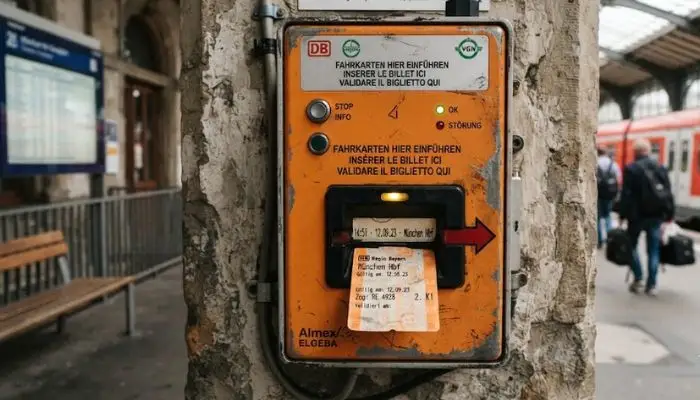
You sometimes need to validate your tickets
In Italy, authorities strictly require validation of paper regional trains, local buses, and rail passes and subject them to a substantial penalty.
Unlike Trenitalia's high speed/intercity lines with non-validation tickets, you need to time-validate all other paper regional tickets/passes with the station office or one of a plethora of validation devices, the example at right being just one; you may validate electronic tickets online.It seems France is phasing out validation, and in those areas still operating, please use a ticket validation machine.
You May Also Read: Travel Packing Tips for Long Trips Pack Light and Travel Happy
Bring a universal plug adaptor
Do not fall under the impression that only one type of power socket standard exists for the whole continent. Whereas most mainland European countries have sockets of type C & F, Great Britain, Northern Ireland, the Channel Islands, Malta, Cyprus & Gibraltar rely on type G sockets, and you can find types E & K north to Denmark & associated countries.
Always take a multi-adapter capable of accepting both USB cables and changing the plug types at the flick of a switch for any destination.
FAQs
1. Do all European countries use the euro?
No. Several European countries use their own currencies, including Switzerland, Poland, Hungary and the United Kingdom.
2. What is the Schengen Area?
The Schengen Area is a group of European countries that generally allow travelers to move between member countries without routine internal border checks.
3. Do European airlines have the same hand-luggage rules?
No. Hand-luggage dimensions, weight limits and fees can vary between airlines, especially among budget carriers.
4. Is public transport a good way to travel around Europe?
Yes. Trains and buses are often convenient ways to travel between European cities and countries, particularly for shorter and medium-distance journeys.
5. Do I need a universal travel adapter in Europe?
It is recommended. European countries do not all use the same electrical socket type, so a universal adapter can be useful when visiting multiple destinations.